Tuesday, February 12, 2013

Thirsting for Justice

Palestinians are thirsting for justice in terms of their fair share of water from Israel. I knew that they were shortchanged, and today I found out just how much. Alex Abu Atta of a coalition of 30 NGOs called Emergency Water and Sanitation/Hygiene  (EWASH) told us that the average Israeli uses four times as much water as the average Palestinian, and some poor Palestinian villages get only one-fifth of the WHO-recommended daily minimum. In the Jordan valley, Israeli settlers actually use 81 times more water per capita than the Palestinians in the area.

Alex Abu Atta of EWASH
Alex says the problem throughout the West Bank is that Israel controls all water sources and extracts almost 90% of the water from the aquifer under the West Bank. Palestinians have no access to the Jordan river, and it is polluted anyway.

The 1995 Oslo accords set an unequal distribution of 80% of the water to Israel and 20% to Palestine, but that target has not been met, and Palestinians get less water today than they did before Oslo.

Alex says Palestinians have only half as many wells as they did in 1967, due to confiscation, demolition, and the long and difficult process of getting permits for new ones. It is also hard to get a permit to build or clean out cisterns, even though they collect only rain water and do not tap the aquifer. Alex says another problem is settler harassment. Settlers have taken over Palestinian springs and on occasion have contaminated them by throwing in dirty diapers or dead chickens.

The Israeli army threatens to demolish this Bedouin's cisterns.
Photo courtesy of Thirsting for Justice
Alex says the Israeli government has turned a deaf ear on appeals to give Palestinians a fairer share of the water. EWASH is conducting a campaign called "Thirsting for Justice" to encourage European countries to pressure Israel to change its water policies to comply with international law and respect Palestinian human rights. If anyone would like to organize a "teach-in" on the problem for World Water Day (March 22), excellent resources are available at www.thirstingforjustice.org. It's time to give the Palestinians their fair share of water.


Sunday, February 10, 2013

A study in contrasts

East of Jerusalem, all 31 of our incoming EAs visited a large, established Israeli settlement (illegal under international humanitarian law), and a small, impoverished community of nomadic Bedouins threatened with forced relocation.
Angela Godfrey briefs EAs in Ma'ale Adumim
Israeli peace activist Angela Godfrey first  told us of the unequal treatment given to Palestinians living in Jerusalem. They account for 40 percent of the city's population, but get only 10% of the city's budget. There is a shortage of school classrooms for Palestinians, and they do not have a single swimming pool, while Israelis have several.

She said the government's master plan calls for continued expansion of Jewish settlements and exclusion of Palestinians from a large area east of Jerusalem, which will drive a wedge through the West Bank and in her view make an independent Palestinian state nonviable.

A small section of Ma'ale Adumim
We saw one of the largest settlements, Ma'ale Adumim, with a population of a about 40,000 and growing rapidly. Angela said expansion continued even during the nominal 10-month freeze, and was even more rapid after the freeze ended. In a reaction to the UN vote giving Palestine observer status, Israel announced plans to build 3,500 more units there.


Waterpark of Ma'ale Adumim


Although this is a desert area, Ma'ale Adumim gets all the water it needs for green landscaping all along the streets, swimming pools, even a water park. Angela says the settlers get eight times as much water per capita as the Palestinians.


Just a few miles down the road is the village of Khan al Ahmar, one of  23 Bedouin communities threatened with relocation.  The tents are home to sheepherders who were first evicted from the Negev in 1951 and repeatedly moved.


Bedouins in Khan al Ahmar
Eid Abu Khamis and two of his seven children
Water is a problem in the village, according to spokesman Eid Abu Khamis. They sometimes go for three days without it, because Jewish settlers trying to force them to move cut the pipes. He says settlers pollute wells, steal animals, and break windows of the school. The army also harasses them, with tanks traumatizing children in the middle of the night. He says within the last two weeks a 14-year-old boy lost a hand due to an army booby trap. A dozen years ago they had 1,600 sheep. Now they only have 140.

Eid says Israel's objective is "to get rid of all Jahalin Bedouins and extend Greater Jerusalem to the Dead Sea."
The Army has been ordered by the Supreme Court to prepare a plan for relocating them in June of this year, after the school year ends. They are hoping for a miracle, so they will not be forced to go to an even less desirable location.


Tire school of the Jahalin


Khan al Ahmar is proud of its school, built in 2009 with international aid from mud and tires, using a design from Argentina and Brazil. It offers classes for 95 children aged 6 through 12 from five villages. It offers primary education to girls, who previously were not allowed to walk the long distance to the nearest school. The school also offers adult literacy classes and a monthly health clinic. If international pressure cannot protect the community from forced relocation, I certainly hope the school can be rebuilt in their future location.


Friday, February 8, 2013

Protest demonstrations

For 25 years Jewish and Palestinian citizens of Israel in a group known as Women in Black have held a  protest vigil against the occupation every Friday at a busy intersection in West Jerusalem.

We join this demonstration, because EAPPI shares the goal of ending the occupation. On this Friday there were a dozen women in black, one man in black, and 6 EAs (including some from placements outside Jerusalem). The woman next to me is Dafna from Detroit, who emigrated to Israel in 1951. She has been with Women in Black from the start in 1988. She told me, "I don't believe in ruling another people. Jews are trying to take over all the land, not just the part they were given in 1948."


Across the street stood a woman with an Israeli flag and a sign reading "Israel forever," the only counter protester.  Some people driving by made obscene remarks or gestures against us, or simply honked, but there were no confrontations. No soldiers or police were present. But the reaction was not uniformly hostile. One orthodox man walking though the plaza with his wife and child said "I appreciate what you are doing."


Mohammed Shamasneh at the demonstration (holding microphone)

Shamasneh family home
Three EAs then went over to a demonstration in front a house on the west side of Sheikh Jarrah where a family of 10 will be evicted to make way for expanding Jewish settlements on March 1 unless the Supreme Court grants the family's final appeal. Mohammed Shamasneh lives there with his wife, parents, and children. He said they are refugees driven from the west entrance of Jerusalem in 1948, and "if the Jews come  back here, we want to go back to our lands, too." If his family is evicted, it will a precedent for others in the same street, which is on the west side of the road to Ramallah.


Mohammed Sabagh
On east side of the road, 66 Palestinians, including 24 children, have been evicted since 2008 to make way for Jewish settlers.  More families have received eviction orders, according to area resident Mohammed Sabagh, who briefed us in his home.

For four years the families in Sheikh Jarrah have been holding a non-violent protest demonstration every Friday against the settlement takeover.  It takes place in a small park on the road to Ramallah. When I observed it, there were about 85 people--a larger turnout than usual, because many had come from the nearby demonstration at the Shamasneh house. There were even some of the Women in Black there.
Weekly protest against evictions at Sheikh Jarrah


Thursday, February 7, 2013

A refugee camp and a Palestinian school

Shufat checkpoint north of Jerusalem was easy. When we re-entered  from the other side, two of us EAs were waved through without even showing our passport. There were no lines, and the metal detector was not in use.

We visited the huge Shufat refugee camp, which according to people we talked to at a school for the handicapped now has a population of 70,000 refugees from all over central Palestine. It is not as clean or well kept as the Deheishe refugee camp I have visited near Bethlehem. The UN refugee program has told EAPPI it lacks resources to care for all of them. It does give food assistance and operates a health center.

Burned out wreck near Shufat bus terminal
Shufat main street
Shufat alley


Just outside the old city of Jerusalem, in Wadi Rababa, we visited an orphan boys school that according to the plaque was rehabilitated with funding "by the American people through USAID for the  benefit of the Palestinian people."
View from Wadi Rababa. Dome of the Rock and Al Aqsa mosque in background
EAs regularly visit the school on Thursdays to accompany the boys when leaving, in case they have problems with Jewish settlers or the police. The school said there have been few problems recently, but we did see one activity of the boys that could trigger a reaction. When they went down the hill some of them threw stones at a house of Israeli settlers, and they made a loud clunk on the metal roof.
Boys leaving school in Wadi Rababa. They threw stones at a Jewish settlers' house, center-right.
A few of the boys also through stones toward a Jewish couple standing further below, but I don't know if they were hit.  Jenny (EA from England) and I both were struck by small objects. Apparently the boys did not understand our neutral mission to protect their human rights.

We then saw police with a chestful of tear-gas canisters patrolling the hill, and a group of 6 having their lunch.They did not interact at all with the boys who passed by, but human rights agencies say that sometimes boys have been arrested for stone throwing and not well treated in custody.

As EAs, it is our duty to observe and report, not intervene in at attempt to stop the stone throwing. or to take sides. We are not pro-Israel or pro-Palestine, but pro human rights.

Tuesday, February 5, 2013

Instantly homeless

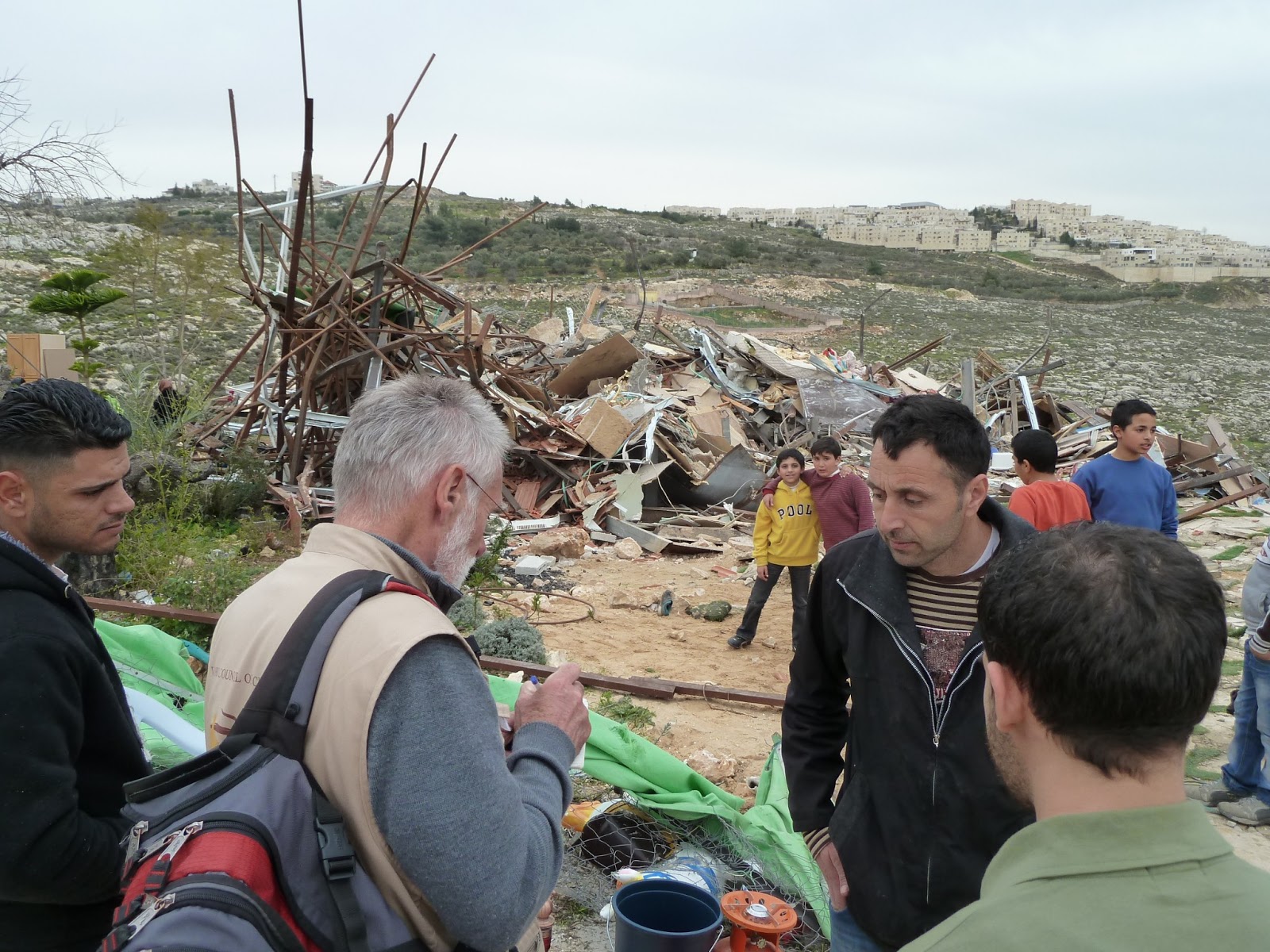
In the Beit Hanina community north of Jerusalem the 45-member Kasfero became instantly homeless when authorities demolished their large home in a few hours with a giant crane I call the stone-eating dragon.

Women decrying the loss of the Kasfero family home
The family  told us they  had been applying for permits for the house for 10 years and paid taxes, but could not afford a lawyer. They have nowhere to go because all their extended family lived in the  building. The women and children were shouting and weeping.

Some family belongings. Can you find the teddy bear?

Getting information on demolition of the Abd Eloiahad home


Nearby the stone-eating dragon had done its work on the home of the six-member Abd Eloiahad family that is expecting a new  baby any day. They had a court order delaying the demolition until February 9 but it was ignored. Soldiers and police broke down their door before dawn at 5 a.m. and gave them 10 minutes to remove their things before the destruction began.


Furniture from the Abd Eloiahad home
Ecumenical Accompaniers contacted appropriate agencies to request emergency shelter and legal aid for both families. According to the Israeli Committee against House Demolitions www.icahd.org authorities destroyed 189 homes last year, displacing 880 people.

Checkpoint monitoring

As part of our on-the-job training, my fellow EA Jenny (from England) and I rose at 3:30 a.m. today for our first experience of checkpoint monitoring. There were were no cars on the streets, and we saw more cats than pedestrians. A 15-minute cab ride with our two trainers (EAs from the outgoing group) brought us to Qalandiya checkpoint, a huge facility between Jerusalem and Ramallah operated by Israeli Defense Forces to keep terrorists out of Jerusalem.

It's easy for everybody to exit Jerusalem. There are just three turnstiles, no checks. Getting in is the hassle. First I went out to watch people waiting to enter. When we got there at 4:45 they were going through smoothly. Then the crowds began. Mostly construction workers. Sometimes there were more than 200 in three long lines that funneled into three 2-ft. wide cages about 15 feet long that ended in a turnstile. They were orderly lines, and gave preference to women with head scarves and men who had stopped to pray. Many were smoking. A large steel-roof structure protected them from the elements while they waited. No toilets; they had been destroyed by vandals. There is a special humanitarian gate that we were told would open at 6, and it did to let a wheelchair through.  Our job on that side was to call the civil authority in charge if the lines became too long, and try to find out why any were denied entry. Few were, because most had learned not to bother coming without the required permit. We also gave a few people at the end of the line time cards to turn in to us on the other side so we could tell how long it took them.

After a while we switched sides. Jenny came out and I joined the line to go in. I guessed the right lane and moved in faster than the other two. After getting through the first turnstile, I had to choose one of five lanes with a second turnstile. Then I passed through a metal detector and pressed my open passport to a window for inspection by soldiers. A couple more turnstiles and I was through. It took me 22 minutes. Then I used three counters to track the number of men, women, and children who exited in 30-minute periods.

George counting persons at the Jerusalem side of Qalandiya checkpoint
In the nearly three hours the accompaniers were there we counted 1,598 men, 88 women, and 101 children (mostly students with backpacks heading for school. Our spot checks showed the quickest transit time was 13 minutes, the longest 28 minutes.  The data is sent weekly to the Jerusalem EAPPI office which forwards it to international organizations.

Surveys show the Palestinians are reassured by our presence, and I feel we help them with opportune calls to the authorities. I feel sorry for the inconvenience experienced by people at the checkpoint, but I did not witness any harassment, humiliation, or harsh treatment. I dream of the day when Israel does not feel it needs this security and the wall and checkpoints can come down. Some have already been dismantled or are inactive.

Sunday, February 3, 2013

Two Jerusalems

I'm back in Jerusalem, this time to begin my three months service with the Ecumenical Accompaniment Program of the World Council of Churches. My fellow EA from the United States feared I had been deported because it took me two hours to get through passport control at the Tel Aviv airport. Actually it was one hour sitting and waiting, 15 minutes of polite questioning about my current and former trips and contacts in Israel, then 45 minutes more of waiting until they checked out my story and gave me back my passport and three-month visa. It could have been worse; one
EA from Peru spent 5 or 6 hours in Passport Control, answering the same questions multiple times, and was strip searched.

This afternoon one EA in the group that is winding up service took us on a two-hour walk through the two very different Jerusalems. In the Palestinian East Jerusalem, people speak Arabic, women wear head scarves, and the streets are crowded with vendors and smell of spices. In the Jewish West Jerusalem people speak Hebrew, many men cover their heads, and the sidewalks are spacious and less crowded.


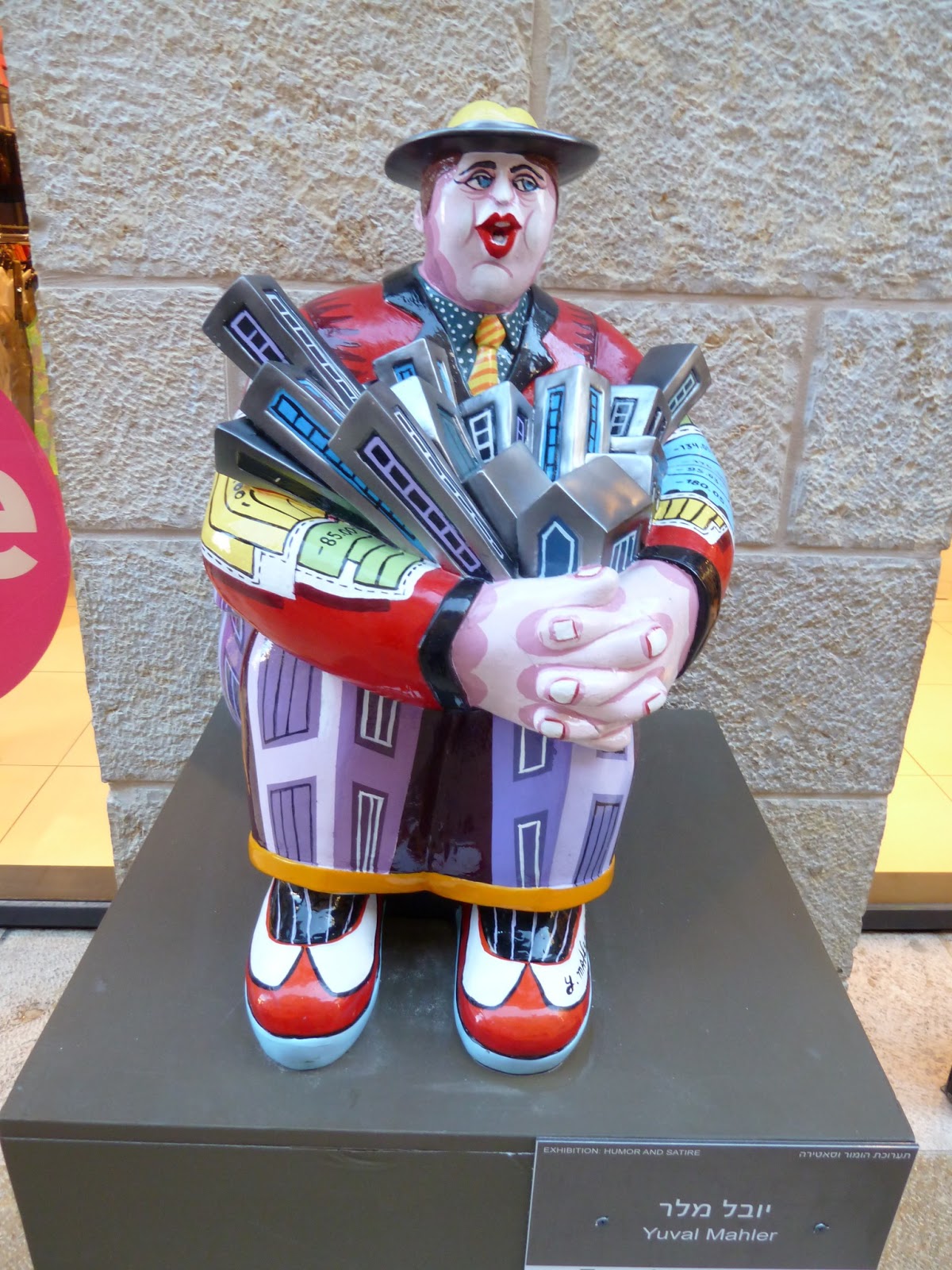
We also saw a pedestrian mall with modern sculptures in West Jerusalem.


In the old city, we passed by the EAPPI Jerusalem office in the Christian Quarter.

I now know my placement. I will be staying here in East Jerusalem for the three months with three women (Jenny from England, Jan from Canada, and Eva from Germany) and one man (Olli from Finland). We will find out more about our specific duties this week. There are a total of 31 EAs from 11 countries in my group, most of them under 35 years old. It is a happy, sociable group. I am excited to be here.