Monday, November 5, 2012

Visit to Arafat's Mausoleum in Ramallah

I traveled today from Israel back to Ramallah in the West Bank, where I will have non-violence training Wednesday and Thursday with the International Solidarity Movement in preparation for a few days of volunteering with that group. As I write this, I hear the call to prayer from a nearby mosque.

After a two-hour bus ride from Haifa to Jerusalem's central bus station (with half a dozen Israeli soldiers on the bus), I took a 15-minute ride on the new light rail train (see picture in previous blog)  to Damascus Gate. I felt a bit guilty about the ride, because the BDS movement has targeted Veolia, the company that built the system with an extension into Israeli occupied East Jerusalem. But the ride was convenient and fun.

My bus to Ramallah
A few blocks from the Damascus Gate (in the same East Jerusalem neighborhood where the IFPB delegation had stayed), I boarded a bus for the 45-minute ride to Ramallah. Since we were traveling  from Israel to the West Bank we got a green light at the Qalandia Checkpoint and breezed right through, although of course there was a back up in the opposite direction. Most of the passengers alighted right after the checkpoint at the big refugee camp.


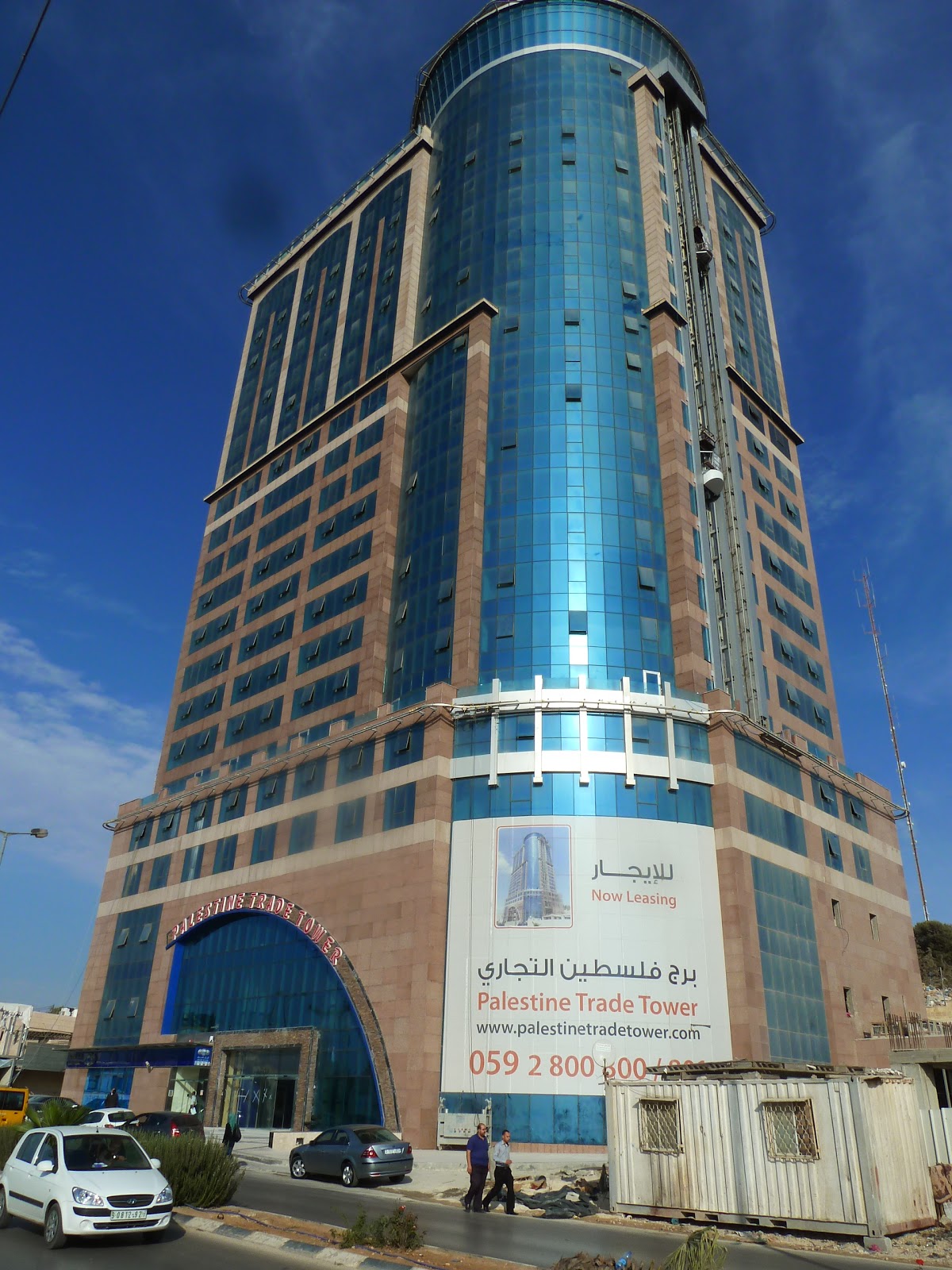
Palestine Trade Tower
On a half-hour walk from my hotel to Arafat's mausoleum I passed a huge new building optimistically called the Palestine Trade Tower. It is not yet occupied. I hope it will be.


Arafat mausoleum
At the headquarters of the Palestinian Authority in the West Bank at Al-Muquata I visited the mausoleum of Yasser Arafat, who headed the Fatah and the PLO from 1964 until his death 40 years later. My lasting image of him was his White House handshake with Israeli Prime Minister Yitzak Rabin in front of Bill Clinton in 1993. Arafat, Rabin, and Shimon Peres shared the Nobel Peace Prize the following year. Palestinian security first told me that photographs of the tomb were prohibited, but when I pointed out that a tour group before me had taken pictures, they relented.


Yasser Arafat, 1929-2004
My guide book to Palestine (Bradt's) says Arafat's remains will be moved to the Haram as-Sharif in Jerusalem (called the Temple Mount by the Jews), if the Palestinians ever gain access to Jerusalem as their capital.  That might take some time.


Sunday, November 4, 2012

High Mass in Isifiya

Reposting Sunday's blog with photos...

Today I went to the High Mass in Arabic in the church right next to the Fallouns' house. It was mostly sung, led by a strong 15-voice choir. The priest wore a gold brocade alb (and a lapel mike) and swung lots of incense. There were three processions with candles and a white flag, the first with the jewel-encrusted Bible, the second with the elements, the third with icons.


The prayers and responses were in formal Arabic, and the homily in colloquial Arabic. I could not understand much of either, but I felt God's presence. The Eucharist was given by intinction, with most older men served first, followed  by women, children, and younger men. Two men held a silk cloth in front of the chalice to catch any drops or crumbs. Many women received the elements bareheaded, but others borrowed a white or  black lace head covering. I asked the priest after the Mass why all 12 of the apostles depicted above the altar had saintly halos because  Judas betrayed Jesus. He told me he had painted the icons himself and put St. Paul in instead of Judas.

My soul was also restored by a visit to the Bah'ai gardens in Haifa.


Part of Bah'ai Gardens


 Labeb's brother Adeed told me that he shares Elias's loyalty to Israel. He admits that Arabs in the West Bank are having "difficulties," but feels that is not his problem. The plight of the Palestinians was reaffirmed for me when this afternoon we drove past the nearby Danon Prison, which Elias told me houses Palestinians, even though under international law they are not supposed to be removed from the West Bank to Israel.

Danon Prison near Isifiya
Elias told me that Isifiya's  population of about 7,000 Druze, 2,000 Christians, 1,000 Muslims, and 500 Jews gets along just fine. Too bad we can't export that peaceful coexistence.

Saturday, November 3, 2012

Home hospitality in Haifa

I'm relaxing in the home of our friend Fakhira's parents, Elias and Labebe Halloun. They are Christians in the predominantly Druze town of Isifiya (or Usfiya), a suburb of Israel's third largest city, Haifa.
Some of the Hallouns around the dinner table


7 of their 9 grandchildren


The day began like a spy novel with a swift and silent pre-dawn collective taxi ride from Jerusalem (arranged by Fakhira) to a crossroads in Megido where by telephone coordination between the two drivers I was transferred to Elias's waiting car. We drove through the Druze town of Daliyat Al-Carmel with its old buildings and five-colored flags. After stopping to see the homes of two Halloun daughters, we caught up with Labebe and I walked  part way with her through the pine forest up a high hill with a commanding view to the 1883 sanctuary and monastery of the Discalced Carmelite Order (a bit of a misnomer,I believe, because the priests were not barefoot but sandaled). 

Carmelite Church
After the mass in the small chapel, the Polish priests told me the reason part of the service was in English was that they had not yet learned the whole ritual in Arabic. We sat down in the courtyard to enjoy tea, coffee, and many kinds of pastries. Before long the site was visited by seven large busloads of Nigerian pilgrims. 

Elias told me that in the Haifa area there are 240,000 Jews, 30,000 Arab Christians, and 10,000 Arab Muslims, and they live in relative harmony in districts that are separated  by custom rather than by law.


Balut
Up near the church I saw a tree with bizarre hairy acorns like nothing I had ever seen. Elias said they are called balut, and they are used for animal food. 

Elias speaks Arabic with his wife, but Hebrew most of the time. He had a good job with the Haifa water company and retired with a pension. Interestingly he is completely loyal to Israel and does not feel any discrimination as a second-class citizen, although human rights groups told our Interfaith Peace-Builders delegation that there are many subtle and not-so-subtle differences in treatment given to Jews and non-Jews in the State of Israel.

In the afternoon we sunbathed and swam along with thousands of others on  Haifa's miles and miles of lovely soft sandy beach on the Mediterranean.

And after dark we had a breathtaking view of Haifa's lights and the Baha'i Shrine from Mt Carmel.

Friday, November 2, 2012

Palestinian Bedouins Struggle to Survive

Settlement of Ma'ale Adummim

Angela
On the way to the humble tents of the Bedouins, we drove through the lush and illegal Jewish settlement of Ma'ale Adummim, a posh community of 40,000 that has no shortage of water. In fact, Bedouin advocate Angela Godfrey-Goldstein told us the settlement uses up to eight times as much water as nearby settlements, and is a veritable oasis of well irrigated palm trees and ancient olive trees taken from Palestinian farmers.

Angela says "There never can  be peace unless the settlers leave."

We drove a few miles down the road to the poor Bedouin village of Jahalin, which is struggling to survive against settler harassment and ongoing threats of forced displacement. What a contrast!


Eid Abu Hamis
Village leader Eid Abu Hamis told us that water and grazing land are critical for his people, whose only source of income is their animals. They used to have 1,600 sheep and goats (plus a few camels), and now are down to 140 to support their 22 families. When settlers closed access to springs and wells, the Bedouin illegally tapped water pipes for a while and now have an arrangement to pay for water from the company. Every year the settlers move their  boundary closer to Jahalin, and they have killed and maimed Bedouin children with booby traps and instead of accepting responsibility, made the parents pay fines for trespassing.
With international help, the community has built a beautiful school from tires and mud, and installed some solar panels to supplement its generator for electricity. Obviously they would like to stay where they are, but their days may be numbered. Eid says the High Court has temporarily blocked the army's order to displace them to Jericho, but it could be reinstated and carried out at any time. "If you take a Bedouin out of the desert, you kill him."

Amjad Alqasis
We learned more about refugees and internally displaced persons from BADIL, the Resource Center for Palestinian Residency and Refugee Rights. Amjad Alqasis told us that last year the Army destroyed one village 22 times, but the Palestinians kept rebuilding it because they had nowhere else to go. He says Israel has a "silent transfer policy," displacing a few hundred people at a time so as not to call attention to it.  
Amjad says Israel has no law prohibiting discrimination, "because the whole legal system is racist and discriminatory." Israeli citizens who are Palestinians are treated inferior to Israeli nationals (Jews) according to 25 different laws.

Amjad sees signs of hope: people are using the term "apartheid" to describe the situation more and more, and South Africa, Denmark, and Sweden have started labeling products made in illegal settlements. He thinks the boycott, divestment, and sanctions movement is critical for ending the occupation.

Rev. Mitri Raheb
That is also the view of the Rev. Mitri Raheb, pastor of the Christmas Lutheran Church in Bethlehem and one of the authors of the 2009 Kairos Palestine appeal of Palestinian Christian church leaders to the international community.  He says "We call for non-violent creative resistance to free the occupiers from the occupation, and BDS is the tool."

Mitri's church is the base of the Diyar Consortium, which serves the whole Palestinian community with emphasis on children, youth, and women.

This was our last visit with the Interfaith Peace-Builders delegation. Tomorrow I am off to visit a Palestinian Christian family in northern Israel.  

Thursday, November 1, 2012

Non-violent resistance in Nabi Saleh

Nabi Saleh
ManalTamini
"The Israeli soldiers shoot tear gas in my home every morning before breakfast." That's what Manal Tamini told me in the village of Nabi Saleh (12 miles north of Ramallah), which has earned international media attention for its weekly demonstrations against the occupation. Every Friday about 70 men, women, and children, accompanied by Israeli and international observers and media, walk nonviolently down the street singing, chanting, and waving flags.  Invariably their effort provokes a violent reaction of tear gas, rubber bullets, and skunk water from the Israeli soldiers.

Manal showed us a video with horrifying and heartrending images of soldiers  beating women and children, a boy screaming after being shot with pepper spray in his eyes, and an observer being dragged into custody. We saw the bloody wound of her own 12-year-old son, who was shot in the side with a high velocity tear gas canister, and sustained liver damage. Manal says more than half of the village's 550 residents have been injured--160 of them under the age of 17, and one  boy was paralyzed.

Janna
Any gathering of more than 10 Palestinians is illegal under Israeli law. Manal has  been spent 10 days in jail and her husband has been arrested four times and had his camera broken. Despite the daily violence, she says they have power from within to keep resisting until the occupation ends. Manal's six-year-old niece Janna sang a poignant song for us about wanting to play, saying "Give me a chance." You can see her bravely confronting the soldiers in this video: Janna link

Manal believes the harsh military reaction to the peaceful protests reflects Israel's fear that the virus of non-violent resistance will spread and spark the third Intifada (uprising).


Sahar Francis
We learned from Sahar Francis of the Adameer NGO that there are currently 4,600 Palestinian prisoners in Israeli jails, most of them political activists, not terrorists. She says all Palestinian political parties are illegal, and mere membership can result in a year or more in prison.  On the positive side, severe torture methods widely used in the past have been abandoned except for serious crimes, but psychological torture is still used, and prisoners can  be tied to a chair for 10 hours.

It was good to hear that the number of persons in administrative detention has been declining, from 300 in recent years to 180 at present. Sahar says "Israel won't give up administrative detention  because it is a powerful tool." The mechanism allows persons to be held for up to six months without charges, and can  be renewed indefinitely. Some have spent six years in administrative detention. It is hard for lawyers to defend them, because the evidence is based on secret materials. Sahar says one of the best ways to help the prisoners would  be to end the occupation.

"If you agree that oppression is wrong, do something about it" said Omar Barghouti, a founding member of the boycott, divestment, and sanctions (BDS) campaign. He reminded us of one of my favorite quotes from Desmond Tutu: "If you are neutral in situations of injustice, you have chosen the side of the oppressor." There is no balance or middle ground between oppressor and oppressed.  Seven years ago a broad coalition of Palestinian civil society organizations called for the international community to implement BDS to achieve the three objectives shown on the right.

Omar Barhouti
Omar says there has been progress in this global Palestinian-led non-violent movement, and Israel fears it as a "strategic threat." The Quakers "have put their money where their mouth is," divesting from Caterpillar, HP, and Veolia. Presbyterians and Methodists have supported boycotts. Hampshire College has divested, and Minnesota has sold its Israel bonds. Omar said the movement's principles are context sensitivity, sustainability, and gradualism, so it is fine if communities initially boycott only products made in the Israeli settlements in the occupied territories. He pointedly reminded us that as U.S. taxpayers, we are complicit in sustaining the occupation, because the United States gives Israel $3 billion in unconditional military aid every year. I think it is up to us to help build a groundswell of public opinion to persuade our government to put an end to that.

Wednesday, October 31, 2012

Settler harassment in Hebron and At-Tuwani

Blocked street, closed shops, settler trash
Harassment of Palestinians in Hebron is flagrant. The immediately visible signs are blocked streets on which Palestinians cannot ever travel, hundreds of Palestinian shops that have  been closed, and huge nets to catch all the trash and garbage thrown down on the Palestinian shopping  street from the Jewish families in the apartments above.
Sundos Al-Hada

Sundos Al-Hada, a 19-year-old Palestinian in the Youth Against Settlements group, knows at least one case of a person wounded by acid thrown down by the settlers. One settler put a stone in her younger brother's mouth in an attempt to kill him, but was never prosecuted. In a separate incident, a settler tried to run her brother down, then beat him, and told police it  was she who beat the settler. She was arrested for five hours.

Sundos told us there are 5,000 soldiers protecting the 400 Jewish residents in the old city of Hebron, and there are some kind ones and some  bad ones. The latter do anything they want; they  scare school children with sound bombs and attack teachers. The Youth Against Settlements run summer camps for kids who can never get out of their homes, fix up Palestinian homes, and lead non-violent demonstrations for freedom of movement.

David Wilder
I asked David Wilder, the pistol-packing U.S.-born spokesman for the Jewish community of Hebron, to comment on the pattern of persistent harassment identified by human rights organizations. He actually said the reports are not objective and overly exaggerated, because the groups are controlled  by Arabs! With respect to movement restrictions, he complained that he has access to only 3% of the city while Arabs have access to 97%  of it. He said Arabs and Israelis lived in harmony in Hebron before the 1929 massacre of 67 Jews, and that Jews "came home" starting in 1967. He told us Arabs shot into his house from the hills and narrowly missed killing his son. He said they found Arabs had desecrated a Hebron synagogue by using it as a sheep pen, and it took six months to clean it out. (The story reminded me of the appalling desecration of the church in Bassa by Jews using it as a cattle  barn, which we heard about yesterday.)  I welcomed David's comments that "I think we take too much money from the United States," and "I oppose the wall."

Village of At-Tuwani, with new school built by community at left, and Jewish settlement at right skyline
Hafez Hareni
In the sheep-raising village of At-Tuwani south of Hebron, non-violence leader Hafez Hareni told us that every family experiences violence and harassment from nearby Jewish settlers. Every day they harass children on their way to school, and every week there is a house or cistern demolition and cutting of olive trees. Settlers have poisoned more than 100 of their sheep. Hafez says the settlers are the most violent and aggressive of all, and conduct physical attacks on men, women, and children, trying to make life harder so they will leave. His first experience with them was when he was 12: settlers beat up his brother and he ran away. His community's non-violent demonstrations, legal work, and international pressure have had positive results: they stopped a separation wall from being built, and the High Court allowed 13 removed villages to come back. Hafez has been arrested for a month at a time after demonstrations, but he remains committed to the non-violent path. We met some international observers from Italy's Project Dove, who provide a protective presence.

Kefah Al-Ahdra
After we picked a few olives, we heard from Kefah Al-Ahdra that seven women of the village got together nine years ago to form a handicraft cooperative, which is looking for markets for its beautiful hand-embroidered products. She says this opened new horizons for the women, who have few rights, are poorly educated, and had traditional roles of working the land and raising families. Women of At-Tuwani linked arms a few years ago in a successful non-violent demonstration to ensure that an electric power project would not bypass their village. Then the women worked days and the men evenings to build the new school and health center, improving the community's quality of life.

I was impressed by the community's resilience and its non-violent approach, and promised to tell the story to all who would listen.


Tuesday, October 30, 2012

Militarism in Israel

Ruth Hiller
 I was moved to tears today by shocking images of Israeli children fondling submachine guns. Ruth Hiller, a U.S. born Israeli leader in the New Profile NGO, told us that Israel's whole education system is militarized, starting with exercises to count tanks and guns in kindergarten. New Profile works with teachers, educators, and youth groups to reduce the impact of militarized education. Ruth's two daughters served in the army, but all four of her sons finally won legal recognition as conscientious objectors and were exempt. The government tried to close New Profile three years ago for inciting people to refuse military service, but the High Court protected them. "We are considered one of the most dangerous organizations in Israel," she says. It would be treason to tell people not to serve, but it is not a crime to provide information on the process. New Profile gets 200 applications for information every month, and more and more youth are choosing not to serve.

Ruth says Israel spends 7.6% of its GDP on defense, compared with 2.8% in the United States. She says, "If we're going to demilitarize, we have to end the occupation--decolonize--and stop  being Zionists." More power to her. (No wonder the government considers her dangerous.)


Kobi Snitz
Seven years ago Palestinian civil society organizations appealed to the world to use boycott, divestment, and sanctions to move toward ending the occupation, ending discrimination against Palestinians in Israel, and letting Palestinians exercise the right of return. We heard today from Kobi Snitz, a U.S.-educated native Israeli neurobiologist active in an NGO called Boycott from Within. He said that cultural boycotts have a big effect, and his group has persuaded several prominent artists to cancel planned shows in Israel. Kobi says the law making it a civil offense to call for a boycott is being challenged in court, but it is  intimidating people who have had to remove things from their website. In terms of academic boycotts, the Israeli activists are calling for no institutional cooperation, not for a ban on articles or visits by individual professors.

Khalil Asi
Speaking of the right of return, in northern Israel, just a few miles from Lebanon, we visited Bassa, the site of one of the more than 500 Palestinian villages destroyed in the ethnic cleansing of 1948. Khalil Asi, who was born there, was just 11 when it happened. The town had 4,000 people, two-thirds of them Christians. Khalil says all of them, except for his family and nine others, sought refuge in Lebanon and eventually in Europe, the United States, and Canada.

Greek Orthodox church in Bassa
Khalil is Catholic, and he showed us the ruins of the Catholic church, the Greek Orthodox church, a common holy site of Saint George, and a house, which is about all that is left of Bassa, now surrounded by an industrial park. I was appalled when he told us that the Jewish kibbutzim had used the churches as cattle  barns, and he had to clean up manure from the floor that was about 20 inches deep. Khalil said he hopes that in his lifetime the Greek Orthodox church, which is in better condition, can be restored.

Altar in Greek Orthodox church
This visit made the Nakba real for me. I think Israel must formally accept responsibility for the damage. but in the case of Bassa there is no place there where the original inhabitants can move back. In any case, they should be entitled to some belated compensation, as Holocaust victims were. After all, the Holocaust and Nakba both amounted to ethnic cleansing.