Wednesday, March 6, 2013

Homeless, angry, and hopeless


This is what we saw a month ago, when the home of the Kastero family in Beit Hanina, north of Jerusalem, was totally demolished by authorities as "illegal construction" on February 5.


Today we visited the family in their temporary housing on the site. Some of the tents, erected by the Red Cross on the same day as the demolition, are pitched right in front of the rubble.

Temporary bathroom


The oldest of the Kastero brothers, Muhammed Saleh, is not living in a tent like his brothers and parents. He is in a "container" that he says cost over $7,000, and he is having trouble making the payments. It has a heater, television, and beds donated by the Red Cross--but the roof leaks when it rains.

Kitchen (left), Muhammed Saleh's container, and one of the tents
Muhammed Saleh Kastero


Muhammed Saleh, who has eight children, worked for 37 years as truck mechanic, but now he does not feel like working at all. "I'm very angry, all the time, since the demolition," he says. He showed us the television video of his children screaming when they came home from school to see their house being destroyed. He says they were seriously traumatized. In his words, "They will not forget this. They are not looking for peace. Maybe they will become terrorists. Israel taught us to be terrorists."

He notes that Israeli authorities only destroy Palestinian homes, never Jewish ones, even those of illegal settlers who build without permits and later become legalized by the government.


Saleh showing his permit application
Muhammed Saleh says he built his house in 2004, and has paid all taxes on the property. He showed us the survey plat and application for a building permit, which cost $5000 to prepare, but was not able to stop the destruction of the home. He has not yet received the bill from the government for the cost of the demolition, but he knows it is coming.

Since the home was the family's main asset, they cannot afford to rent a new one, even if they could find one that his big enough for all 28 of them. So he has no idea how long they will be in the temporary quarters. They expect to finish two structures in a couple of weeks so the rest of the family can move out of tents, but they will be portable, in case they are served another demolition order.
New homes for the Kostero family


Tuesday, March 5, 2013

Discrimination Jerusalem-style

Jerusalem City Hall, Bldg. #4
A member of the Jerusalem City Council, Meir Margalit, says "There is systematic discrimination against Palestinians in the city so they will leave by themselves." Briefing EAs in his office at City Hall in Israeli West Jerusalem, he said that Palestinians account for 38% of Jerusalem's population, but get only 11% of the city's budget. He says 75% of the Palestinians in Jerusalem (and 86% of the Palestinian children) live in poverty.  As he puts it,  "poverty and illiteracy are tools of control," and the city's policy toward the Palestinians is "be poor and shut up."

Councilman Meir Margalit
East Jerusalem garbage bin

Councilman Margalit says welfare, garbage collection, and education are three areas in which Jerusalem Palestinians are shortchanged, but they get adequate health care.


East Jerusalem school


Mr. Margalit says thousands of Palestinian children in Jerusalem cannot get into schools  because there are not enough spaces, and 40% of Palestinians drop out before completing school. In Israeli West Jerusalem the dropout rate is only 1%.

The Councilman says that the municipality finds pretexts to deny building permits for Palestinians, so their homes can be demolished. The draft master plan would permit 13,450 more Palestinian homes, but in an area that people are unlikely to move to. For cultural reasons, they prefer to stay in their present communities and build without permits, hoping the structures are not destroyed.

If present growth trends continue, the Councilman says Palestinians will be a majority of the population of Jerusalem  by 2025.  He believes that the city can still be the capital of two states, Israel and Palestine.

Mr. Margalit is now serving his second term on the City Council. He was elected by Israelis who share his anti-discrimination views--not by Palestinians, because they boycott the elections to protest the illegal annexation in 1967. He says there are only two other leftist members on the 31-member Council, so they do not have enough votes to change policies. He thinks that many Israelis would like to see an end to the occupation, but keep voting for rightist parties from inertia.

Jerusalem EAPPI Team: George from the U.S., Jan from Canada, Eva from Germany, Jenny from the U.K, Olli from Finland

Monday, March 4, 2013

A happy ending

Bus crossing Jubara Checkpoint
The Palestinian village of Jubara is in the "seam zone" (between the Israeli separation barrier and the Green Line). On school days the Palestinian Authority Ministry of Education pays for a bus to take them from their village through the Jubara Checkpoint to attend school in al-Ras, just up the hill on the east side of the barrier.

On the morning I was there, the students did not have to get off the bus at the checkpoint, but the EAs who monitor it regularly told me that sometimes the soldiers make them get off just to harass them. It is apparently at the soldiers' discretion.

Bus arriving at school
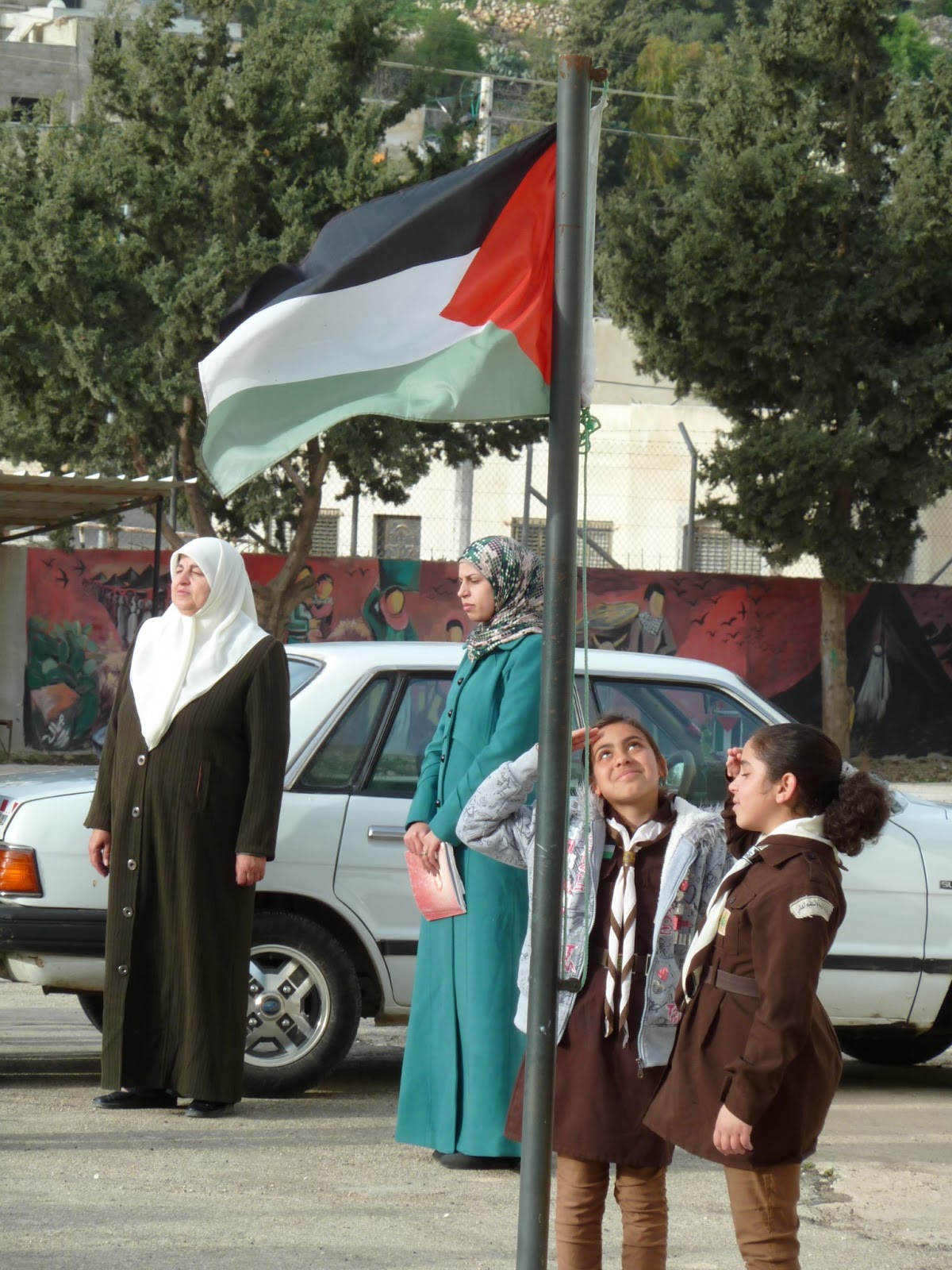
We followed the bus to the al-Ras school, where it arrived without incident a few minutes later. The 200 students held their opening ceremonies outside, in formation by classes, with songs, prayer, and flag-raising.

School formation for opening exercises


Flag raising


Although the al-Ras school serves grades 1-12, primary school students from Jubara don't have to come there because they have their own new school in Jubara.

New primary school in Jubara (beige building with wall)


There is a happy ending for this story. We learned from our driver/translator that Israel has already begun to implement a decision to move the separation barrier west to the Green Line in this section, so that there will be no checkpoint between Jubara and al-Ras. I don't know the reason for Israel's decision, but it is good news for the Palestinians.

Sunday, March 3, 2013

Herding workers like cattle

Taybe Checkpoint for Palestinian workers entering Israel near Tulkarm
Kabob stand at entrance
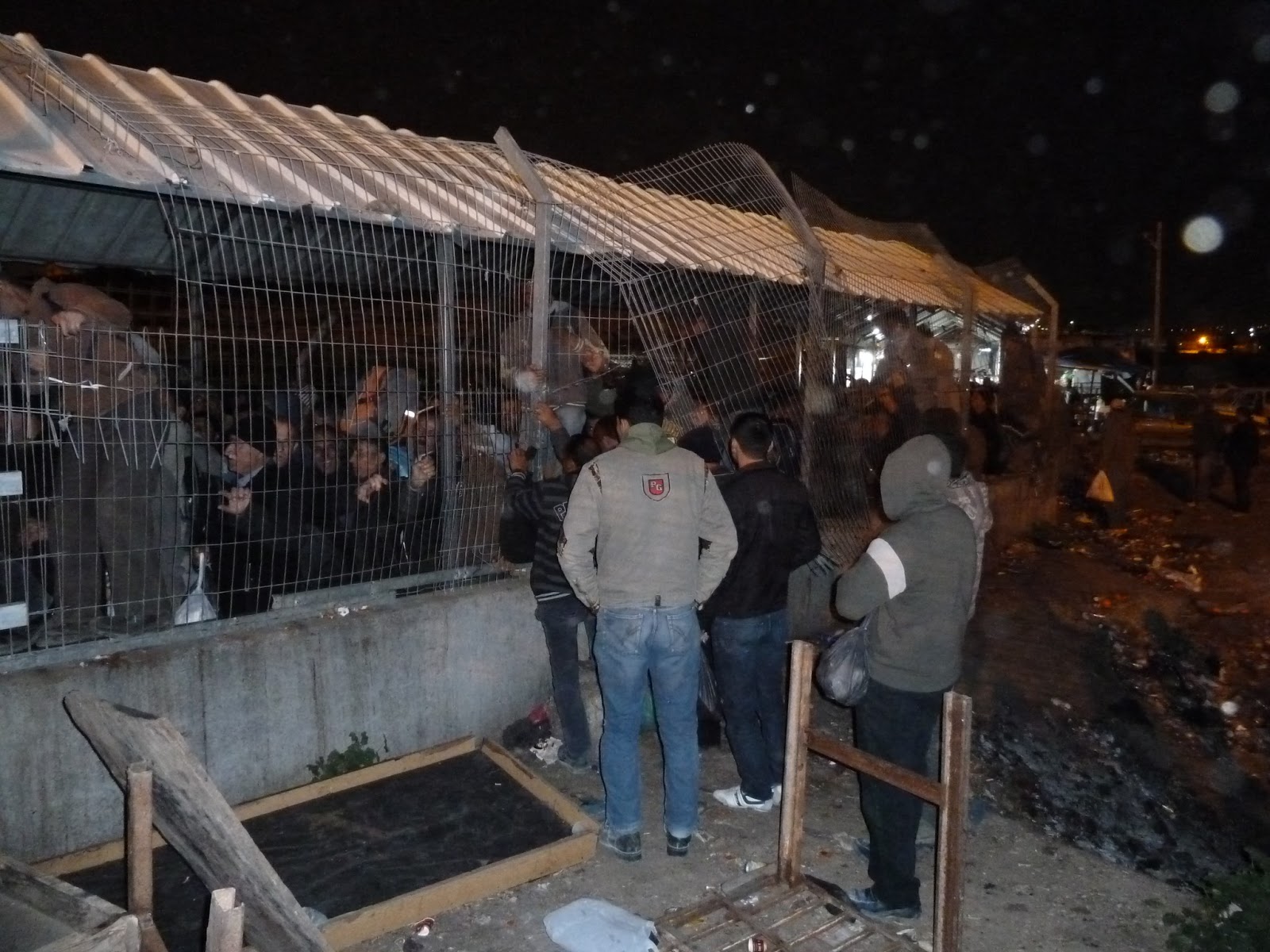
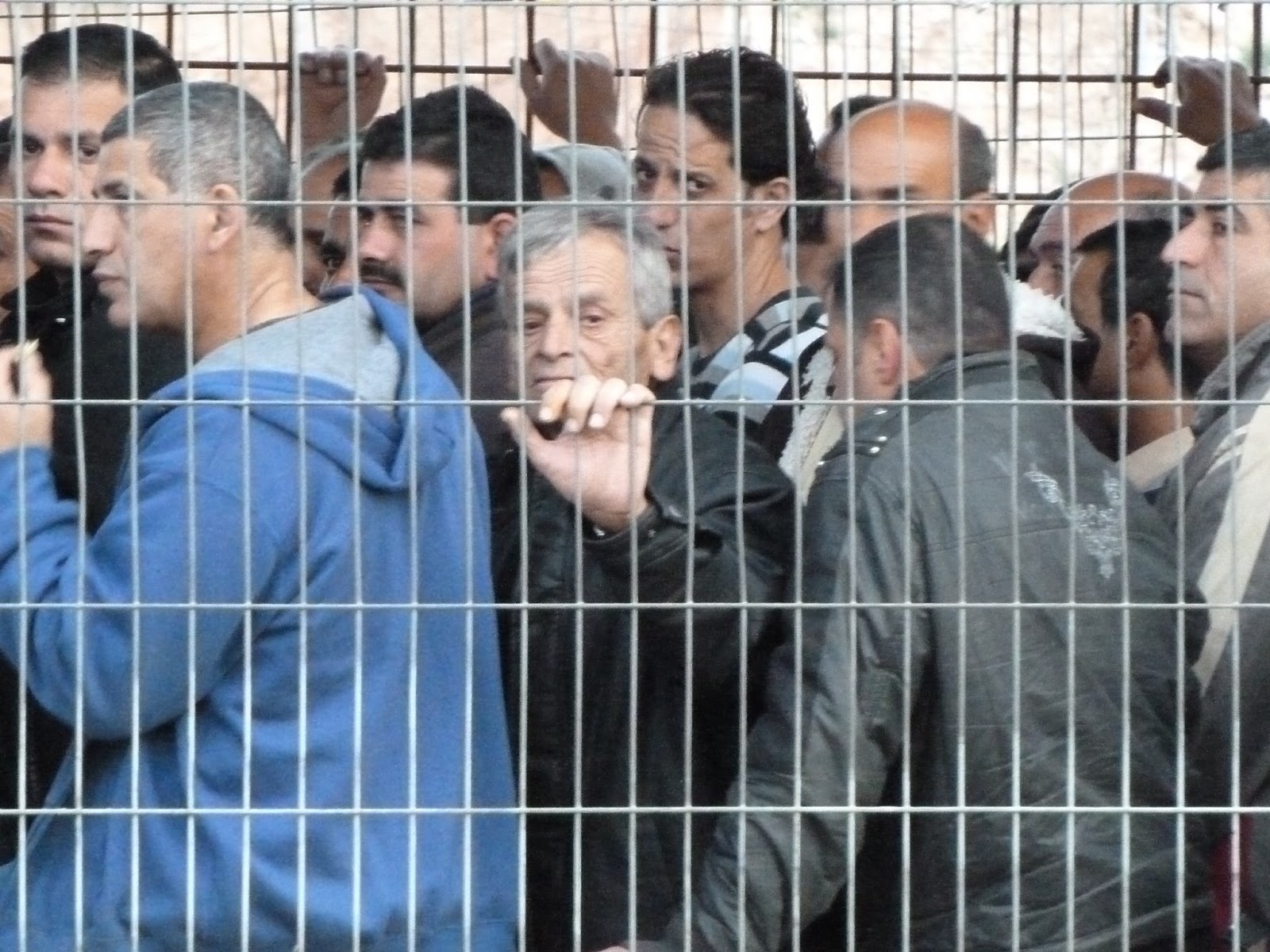
In three hours early this morning I saw over 5,500 Palestinian workers herded like cattle through cages to pass an Israeli checkpoint to get to their jobs in Israel. Most were understandably angry and frustrated.

At the entrance to the Taybe Checkpoint near Tulkarm there are 25 flourishing food stands that fortify the workers for the pushing and shoving nightmare in the cages.  Then the workers must pass through a wide cage about 80 feet long, followed by four narrower short bends of cages before they reach two turnstiles that enter the checkpoint proper. I did not see the inside of the checkpoint, because internationals are not allowed to enter. EAs monitor it only from the West Bank side.

The long cage
The short bends of cages
Women's fire


When we got to the checkpoint just before it opened at 4 a.m., we found some women warming  themselves by a fire and others standing at the humanitarian gate, which puts them into the last bend of the cage just before the turnstiles. One woman told us that Friday the humanitarian gate was not open at all, so they were jostled by thousands of men in the main gate, which is culturally repulsive. Before the opening today the main lane was filled with men all the way back to the food stands.
Opening of checkpoint at 4 a.m.


The checkpoint opened promptly at 4, as did the humanitarian gate. Unfortunately the humanitarian gate was closed in four minutes after the last of the 78 early women went through, so later women entered through a hole in the fence in the long gate.

Some men decided to follow the women's example and cut in line through the same hole, evoking screams of protest from others in the line.  Some also tried to get ahead by walking on top of the narrow concrete foundation of the chain link fence.

Men cutting in line through the hole


The caged faces of frustration and despair

Oher EAs from Tulkarm who regularly monitor the checkpoint said it was slower than usual this morning. In the fastest half hour we saw 1,272 go through, but in the slowest half hour there were only 512. We like to think it was more than a coincidence that the pace improved after two calls to the humanitarian line.

A couple hundred workers sulked outside the cages as the line dwindled, because with the slower processing they were too late to make it to their jobs.


Landscaper Nipham explains his problem to EA Roland from Sweden

One such worker was Nipham, a landscaper from the northern West Bank city of Jenin. He says he has to work in Israel to support his family, with two sons in the university, because he cannot find a job in the West Bank. He must get up at 3 a.m. to get to the checkpoint by 4. He says he earns about $30 a day in Israel, but has to spend $10 of that on bus fare to get to the checkpoint.
Today he said the line was too slow for him to make it through the checkpoint in time to get his employer's bus to the job on the other side of the barrier at 6:15, and the bus would not wait for him. He just gave up, and went  home to sleep, $10 poorer for the bus fare.

With Father Ibrahim Nairouz in Nablus
I felt overwhelmed by the visions of the men and women in the cages, sharing their anger at the unfairness of the system. If only the 45-year occupation of the West Bank could end and the barrier could come down.  If only the United States could stop giving $3 billion in unconditional military aid to Israel every year.

My spirit was refreshed by worshiping with nine other EAs from the northern placements at St. Philips Anglican Church in Nablus with Father Ibrahim Nairouz, my good friend from former visits. He encouraged the EAs to continue working for a just peace.

Saturday, March 2, 2013

Stress with a capital "S"

KafrQaddim
The residents of the Palestinian village of Kafr Qaddum, a 35-minute drive south of Tulkarm, experience stress with a capital "S." It's all because of the illegal Israeli settlement of Quedumim that has grown up beside them.

Typical street in Kafr Qaddim


Former mayor Abu Musad
In the municipal offices, in a building financed by USAID, former mayor Abu Musad told us the village has a population of about 3,800. 85% of the economy is based on olive cultivation, but Abu Musad says Israeli settlers have burned and cut 600 of the olive trees, and come every week to try to take over land from the village. He says Israel does not want NGOs to help the farmers.

Abu Musad says that a decade ago the neighboring Israeli settlement of Quedumim felt insecure because two or three houses were near a road used  by the villagers, so settlement security guards started gradually blocking it. Talks with Palestinian and Israeli authorities went nowhere. Kafr Qaddum proposed they just build a fence around the houses that felt at risk, but Israel told the village to build another road instead. Since 2004 the road blockage has been total, so the Palestinians have to travel almost 8 miles to the main road instead of less than one mile.

At the demonstration site, where the road is black from burning
tires, Abu Musad points to settlement of North Qedumim
Every Friday since July 2011 there has been a demonstration in Kafr Qaddum to protest the roadblock. Israeli soldiers forcibly represses them. EAPPI used to observe the protests, but stopped last August after three EAs were arrested. Abu Musad says that at yesterday's demonstration two young men from the village and a coordinator from the International Solidarity Movement were beaten with sticks and arrested, and another resident is still hospitalized from injuries.

We walked down the road to the unmarked boundary between Palestinian and Israeli control. Abu Musad said, "Be careful, they are taking picures of you." As we returned to the taxi, a military personnel carrier came down from the settlement and three soldiers with machine guns jumped out and came toward us. "What were you doing crossing the line," one asked. Abu Musad replied in Hebrew that we had not crossed the line. They called their superior, apparently to relay our response, and told us we could go. Then they checked out an unfinished house nearby and left.
Soldiers checking a house after confronting us


Soldiers retreating
We then spent two hours visiting the Abu Ihab family at their home right beside the site of the weekly demonstrations. Emme Ihab, the mother of 10, told us that when the demonstrations started in 2011 soldiers used their roof, broke their TV dish and water system, and left 30 used tear gas canisters. Every Friday the family has to endure tear gas and the nasty-smelling "skunk water" used to repress the demonstration, even though they stay indoors. She says last weekend the demonstration and violence lasted for three days.

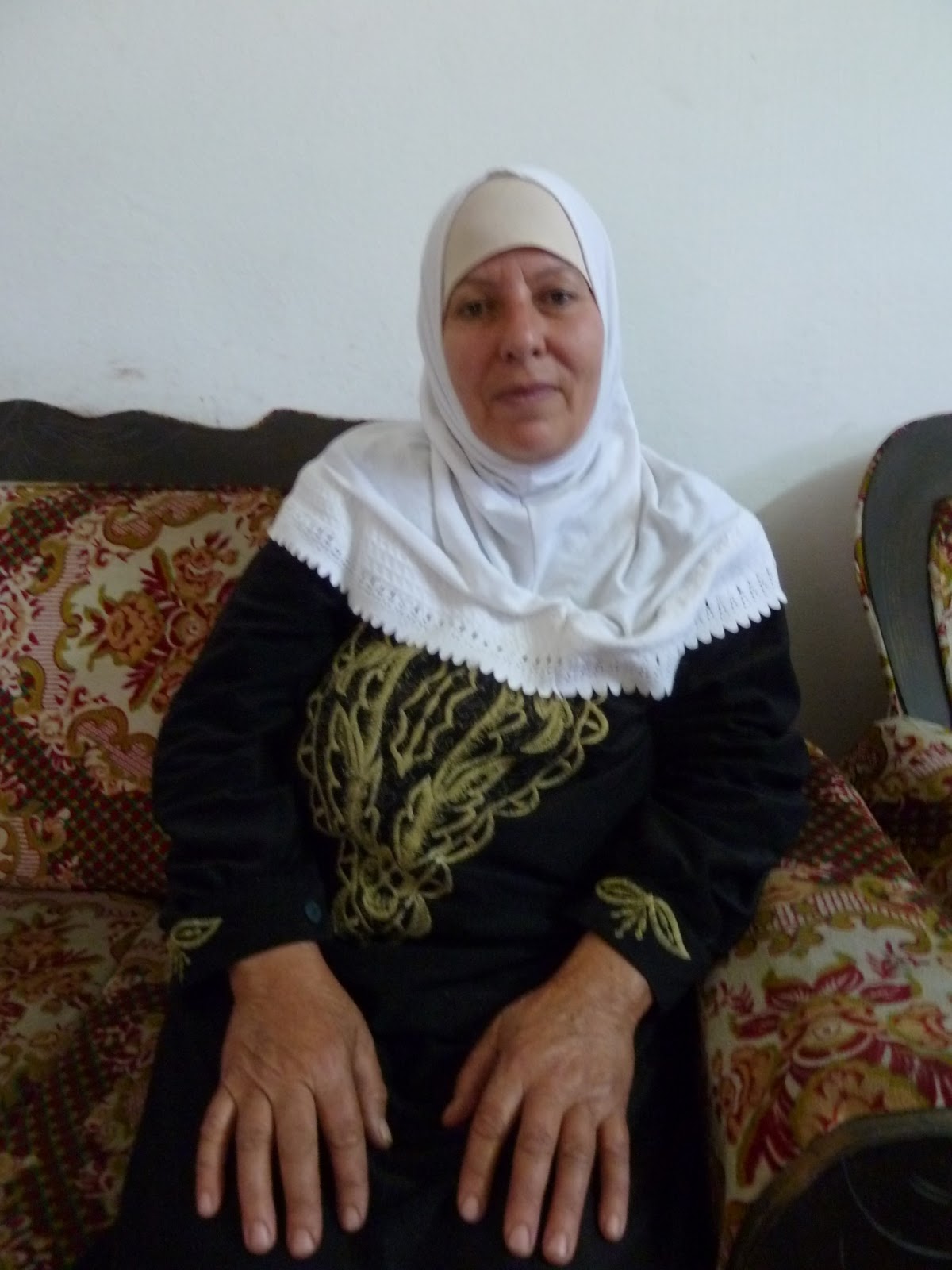
Emme Ibad


Emme Ihab says tear gas killed 2,500 ready-for-market chickens that her two oldest sons had borrowed money to raise. Since they couldn't repay the debt, they are now in a Palestinian jail.

She says they cannot walk behind the house for more than 50 yards without permits from Israeli authorities, even though the land is theirs, and planted with olive trees. "It's a real prison," she says. "We are suffering a lot from the settlers and the army."

You might think Emme Ihab is anxious to move to a safer location, but that is not the case. She calls the house her paradise and says, "We will stay here. We will die here. We will not move."

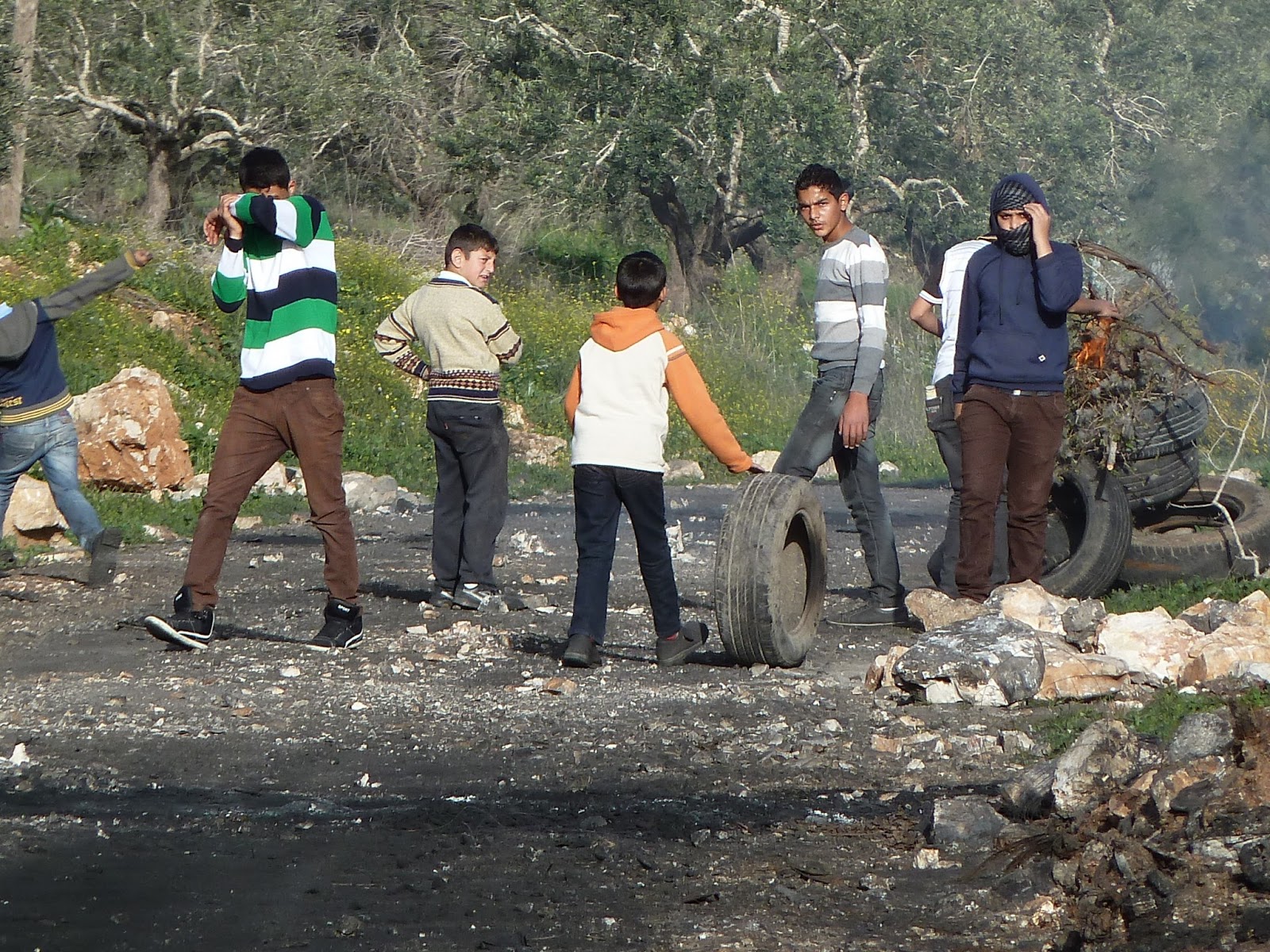
As we left the house, we saw boys blocking the road with stones and rolling in tires to be set afire. We knew the soldiers would be down soon, but did not wait to see them. As we drove back to Tulkarm, the black smoke was clearly visible. What a life!
Boys rolling in tires for new demonstration
Smoke from burning tires

Farming made harder

Separation barrier in farmland north of Tulkarem


A decade ago, when Israel was experiencing suicide bomber attacks in the second Intifada, it started building the separation barrier.

A few miles north of Tulkarm, the barrier is no 27-foot-high concrete wall, as it is in some other places. It is only a chain link fence with some concertina wire, just enough to impede access by Palestinian farmers to their land in the "seam zone" between the barrier and the Green Line (1949 armistice line).


Deir al-Ghusun agricultural gate, waiting shelter at right


Israel allows farmers limited access to their fields though half a dozen agricultural gates in theTulkarm area. They have to apply for permits through Palestinian and Israeli authorities, and the process can take between a week and a month.

We visited the Deir al-Ghusun gate, which is only open for 45-minutes three times daily: morning, noon, and afternoon. If the farmers are late, they cannot enter.


Three donkeys are first in the line to enter the gate. Their masters
came at 6 to be ready for the 6:30 scheduled opening
Local farmer describes access problems

A local farmer says the  barrier destroyed access roads on which he used  to take a tractor to his almond and olive trees. Now he must go by donkey. (Several tractors did transit the gate this morning.) He complains that the gates are not open on Jewish and Muslim holidays, even though he would like to work on holidays. He says, "We were turned back for two days when we were picking olives." He knows of three people who were injured while in the fields and had problems getting medical assistance. "What is needed," he says, "is to take down the wall."


Farmers entering the gate after it opened at 6:37, seven minutes late. It closed punctually though, at 7:15
Female commander of the army unit checks individual permits
Interceding unsuccessfully for farmer denied access


One farmer had a problem this morning. His car broke down so he could not get to the gate for which he had a permit before it closed. He came to Deir al-Ghusun in the hope that the soldiers would let him in,  because his land is accessible from both gates. Ecumenical Accompaniers interceded with the soldiers on his behalf, but they were adamant. Since his permit was not for this gate, he was not allowed in. He will lose a day of work.

Friday, March 1, 2013

So near and yet so far

Tulkarm
Separation barrier near Tulkarm
The city of Tulkarm, on the northwest border of the West Bank, is only about 8 miles from the Mediterranean Sea, but most of its 81,000 residents will never be able to swim in it. They are barred from crossing the Israeli separation barrier unless they have a permit for day work. I have come up to the EAPPI placement from Jerusalem for three days and will get a chance to monitor workers crossing the main checkpoint into Israel on Sunday.


Boy with horse cart crossing Jubara Checkpoint

Today I saw a smaller checkpoint, Jubara, which EAs monitor because students from a village in the "seam zone" (between the Green Line and the barrier) need to come through in a bus to attend school in the West Bank.

As soon as they come through, they see some nasty concertina wire left by Israeli authorities along the road.


Far'un Agricultural Gate


There are also a number of agricultural gates around Tulkarm that are monitored by EAPPI to make sure they honor their opening times. These gates are supposed to be open three days a week, and three times a day for 45 minutes, to allow farmers from the West Bank to work on their fields in the seam zone.


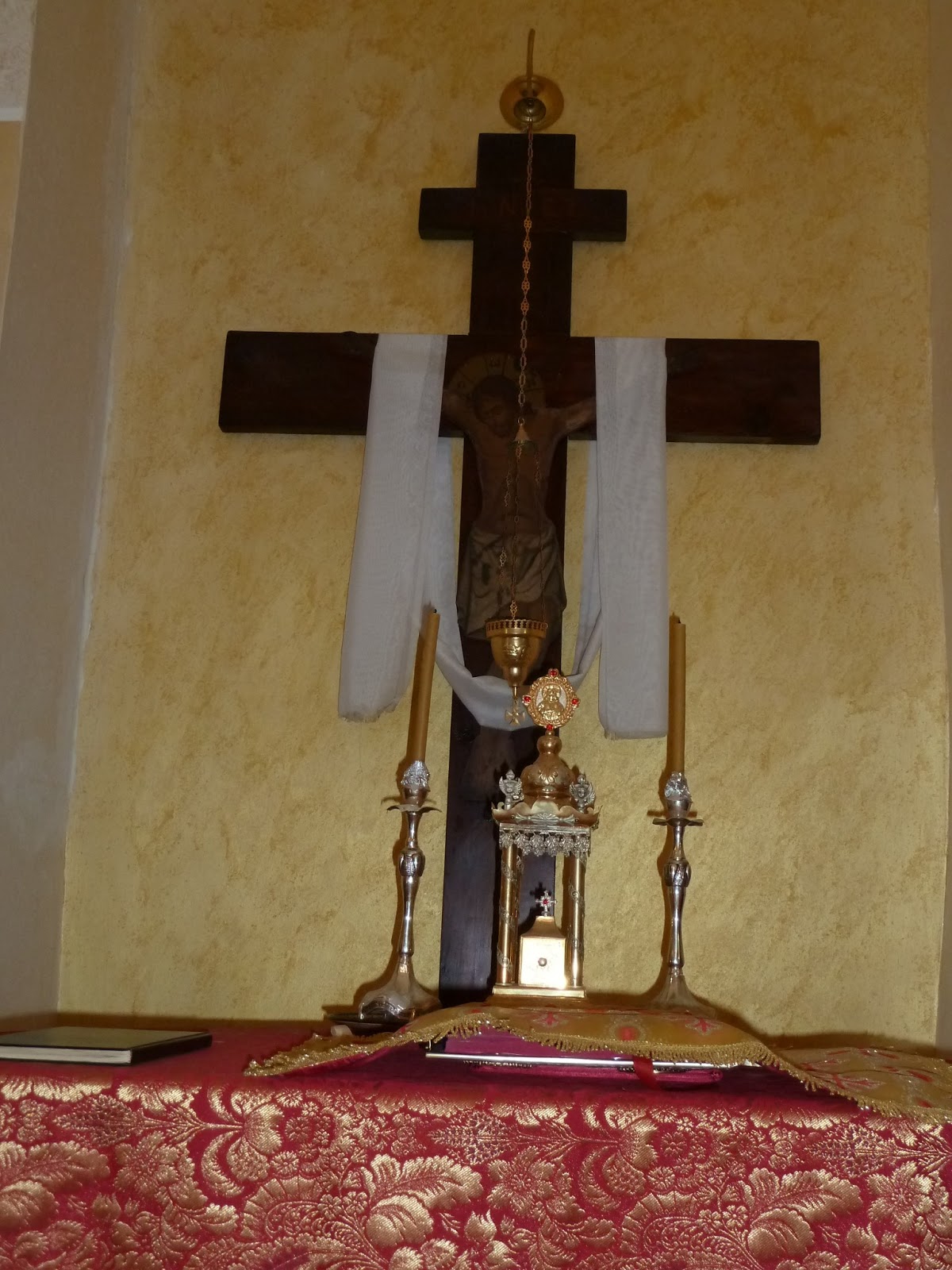
Back in town, we visited the only Christian church left in Tulkarm, a small Greek Orthodox church lovingly restored by Daoud Firoba and Muslim friends after it was destroyed by fire in 2006. Daoud's family, and a Catholic family, are the only two Christian families left in Tulkarm. Before Israel occupied the West Bank in 1967, the city had more than 1,000 Christians, but many fled to Jordan, Lebanon, and Bethlehem, according to Daoud. Today less than 2% of the West Bank population is Christian.

Interior of Greek Orthodox Church restored and maintained by Daoud Firoba
Daoud and 18-year-old son Mitri, who wants to study law
The church is used only occasionally for worship. Daoud and his family generally worship in other cities. They go to Bethlehem for Christmas and Jerusalem for Easter, and he says there is no problem getting permits from Israel.

Since he restored the Tulkarm church, he says he has no intention to move. His philosophy is exemplary. "I love everyone," he says. "Muslims help me and love me."


Tulkarm church altar
Belfry