Tuesday, February 19, 2013

O Little Town of Bethlehem

I'm taking a three-day break in the "little town" of Bethlehem, just south of Jerusalem, which now has a population of 22,000, not counting the thousands of tourists that pour in every day. But I cannot escape the sad reality of the occupation. Three young female border guards with their green berets stopped my bus for a random check. It only took four minutes, and they just looked at my passport cover; did not open it. But they pulled two young men off the bus and detained them for questioning as the bus pulled away. I have no idea what happened to them.


In Bethlehem the towers of mosques and churches share the skyline with towers of Israel's separation barrier. My hotel is directly across the street from the 27-foot concrete wall, which blocks me from visiting Rachel's Tomb. A sign explained that the Oslo accords called for it to be under  Palestinian authority, but Israel assumed control and built the barrier around it.


The barrier has been profusely decorated by graffiti artists, with a weeping Christ and weeping Statue of Liberty, among other symbols.


Writing says "This is illegally occupied land
in the State of Palestine"
There are dozens of personal stories posted on the wall, like this one of a "dying woman."


A more inviting construction than the separation barrier is a millennium sculpture on Manger Street with an encouraging message of hope for coexistence.

The "untamed yearning for hope" was also evident at the Palestinian Conflict Resolution Center, Wi'am, whose office I visited briefly on my stroll. Their programs for conflict transformation, restorative justice, and meditation seek "to be a center of hope to a people living under occupation and a world that is brimming with the cries of injustice and oppression." (For more information about Wi'am, see their website at www.alaslah.org.)  

I also noticed a Christmas poster from the Ministry of Tourism and Antiquities in my hotel lobby with these encouraging words: "Justice is possible and hope is justified."


Monday, February 18, 2013

Another family loses its house

Jabril Abu Safar sitting on all that is left of his son's home
EAs interview members of the family
This morning there was another house demolition in Beit Hanina, north of Jerusalem. A single-family home was completely bulldozed in an hour before the Ecumenical Accompaniers got there.

The owner of the house, Rahed Abu Safar, is in an Israeli jail. His wife and three children were not in the house when the demolition crew, police, and soldiers came without warning, because they had spent the night with Rahed's grandfather at the Shufat Refugee Camp. The family says it received an eviction order for living in a house without a permit, and the authorities want to build a road through the area.

To seek help for the family, we reported the incident to the United Nations Office for the Coordination of Humanitarian Affairs in the Occupied Palestinian Territory and the International Committee of the Red Cross.

Rahed's cousin Nasser told us, "It's very difficult for our family.We have to be patient. What else can we do? This is our country." According to the Israeli Committee Against House Demolitions (ICHAD), Israel has destroyed 27,000 Palestinian homes since 1967.
Jabril removing furniture from the rubble

Sunday, February 17, 2013

Praying for Palestine AND Israel

St. George's Anglican Cathedral in East Jerusalem


One of our pleasanter--and uplifting--duties as Ecumenical Accompaniers is worshiping at different churches. Today I chose my namesake, St. George's Anglican Cathedral, a large Gothic structure built in 1898 and 1910. They have two English services and one Arabic service every Sunday. I enjoyed the rich liturgy of the Book of Common Prayer. The Dean of the Cathedral, Hosam Naoum, greeted me warmly. He is a member of the local EAPPI advisory committee.


Interior of St. George's
Main stained glass window


Inside the church there is this poster printed by a British organization, Christian Aid, with what I think is an important thought based on a prayer of a Palestinian Christian. As a matter of fact, in the service we prayed for both the President of the Palestinian Authority and the Prime Minister of Israel (in that order).

EAPPI's policy is that it is not pro-Israel or pro-Palestine but pro-human rights, seeking an end to the occupation based on international humanitarian law and the relevant United Nations resolutions.

Saturday, February 16, 2013

Back to the beleaguered Bedouins

Three EAs from the Jerusalem team returned to the nomadic Jahalin Bedouins at Khan al Ahmar who are threatened with forced relocation by Israeli authorities (see Feb. 10 blog). The team tries to check in with them every Saturday.

Nasser (left) describing the Bedouins' problems through an interpreter (center)
We chatted today with Nasser in front of his colorful house. He told us that last Thursday they were visited by police who warned them to stop grazing their sheep and goats on the hill opposite the community or face arrest and fine.  They have nowhere else to graze the animals, which are their livelihood. They are considering what to do next.

The community is extremely poor. Nasser says they get food  from the UN every three months,  but it only lasts for a month. There are agricultural and construction jobs in Jericho, but they pay only about $16 a day. He works 4 or 5 days a month.

Nasser's daughter Razan
Nasser's 5-year-old daughter Razan suffers from "psycho-motor retardation," according to a doctor's written report that Nasser shared with us. The doctor recommends evaluation in a hospital, but unfortunately the family cannot afford it.


George trying his soccer foot
Part of our accompaniment mission involves interaction with children. We had a chance to play a little soccer and "keep away" with Nasser's four sons and his older daughter, forgetting for a few moments the weighty burden of the occupation and the threat of the community's forced relocation.

Friday, February 15, 2013

Two peaceful protests

Tent for Friday prayers in Silwan
In the Palestinian community of Silwan, a short walk downhill from Old City of Jerusalem, Muslims have been gathering for four years in a tent and on the street for midday Friday prayers. It is a religious observance with a political context. The organizing committee suggests talking points for the Imam to include in his sermon, such as recent police violence in the community and the threat of demolition of homes.

When we arrived prayers were underway in the tent, and within half an hour cars blocked the street and the throng of worshipers inside and outside had swelled to about 200, with many spreading their prayer rugs on the street.
Worshipers at Friday prayers in Silwan
Abid al-Halim Shlode chats with EAs
One of the organizers of the event, Abed al-Halim Shlode, told us he fears that time is running out for Palestinians in 88 houses in the Al-Bustan neighborhood that Israel wants to demolish, ostensibly to build an archeological park. Palestinians say the real agenda is political, to expand the line of Jewish settlements stretching east from Jerusalem.

Another big concern in Silwan, according to Abed, is the arrest of minors. He says in the past two years Israeli police have arrested 1,351 children under the age of 13, and their parents had to pay fines equivalent to $250 for their release.

Israeli police watching Silwan prayers
There was no violence at the Friday prayers. A small group of police monitored the event from a hilltop perhaps 300 yards away. Abed said there were probably 100 more police in readiness just over the ridge in case their intervention was needed. He said police had broken into houses in the community last night and beat the occupants, including women.


There were no police at all at the other nonviolent demonstration we observed today, in Sheikh Jarrah, which has also  been a weekly event for four years. The group was much smaller than the one we saw last week, perhaps 40 people. More than half of them were Israelis strongly opposed to the occupation and the evictions in Sheikh Jarrah to make room for Jewish settlements. Some were the "Women in Black" (see blog of Feb. 8). The Shamasneh family, facing eviction in 14 days, was there.
Sheikh Jarrah weekly demonstration
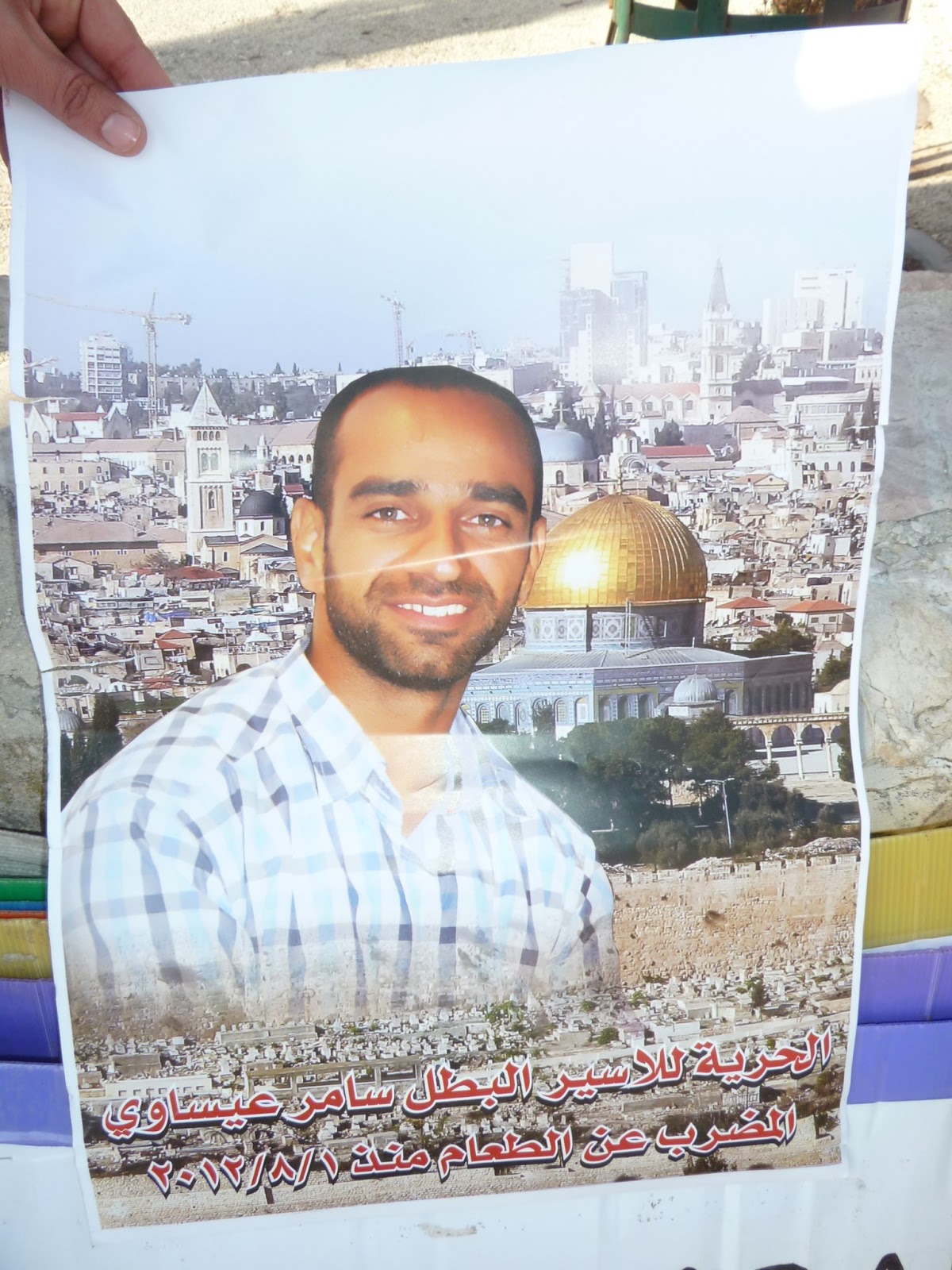
Hunger striker Samer Issawi
This week's demonstration in Sheikh Jarrah also sought to call attention to the plight of a Palestinian prisoner who has been on a hunger strike for over 200 days and is reportedly near death. Samer Issawi began his hunger strike on August 1, 2112, to protest his detention without charge or trial. The Israeli human rights organization B'Tselem (www.btselem.org) says "As of December 2012, Israel is holding about 178 Palestinians in administrative detention in facilities run by the Israel Prison Service (IPS)." The number was nearly 1000 in 2002 during the second Intifada.

In a park behind the demonstration was a sign of hope: some early spring blossoms...

Thursday, February 14, 2013

A pleasenter school accompaniment

What a difference a week makes! When we visited the orphan boys school in Wabi Rabada last week (see Feb. 7 blog), there was much stone-throwing by the boys, and police were patrolling with their tear gas canisters ready for action. This week we saw only one boy tossing a stone at the Israeli settler's house behind the school, none at all striking the Ecumenical Accompaniers, just a couple of boys throwing stones at each other. There were no police patrols.

Before classes were released, we told the principal about our experience last week, and our impression that the students may not understand our mission to help deter human rights abuse. We made a date to visit the classrooms next week to be introduced, and we made it a point to engage in friendly chats with students on their way down the hill. We don't know whether the principal passed some word down to the students today, or whether it was pure luck that today's school accompaniment was incident-free.

Wednesday, February 13, 2013

Walking in the Light

Incoming Jerusalem team preparing to receive the light
At an impressive "handover ceremony" In a chapel of the Lutheran Church of the Redeemer in Jerusalem, the EAPPI teams for the seven placements were formally commissioned today to begin their three-month assignments.  We were reminded of Jesus' teaching in Matthew that we are the "light of the world." The outgoing team charged us to walk in the Light with the people of Jerusalem, "with kindness, hope, patience, and love." They called on us to "listen to the stories of the people of this land and accompany them in solidarity."
Incoming team (left) has received the light

The closing prayer was: "May God grant you wisdom in using your knowledge and skill, diligence in advocating for the people of this country and to the people at home. In the midst of suffering and sorrow, in the midst of human kindness and ingenuity, make a faithful witness to the hope of God's gift of new life the world. Let it be so. Amen."